Choose a Business Structure

 Description: 

This stage involves deciding on the legal framework under which your business will operate (e.g., sole proprietorship, partnership, limited company). This decision has significant implications for liability and taxation.

Why it’s important?:

  • The business structure determines your personal liability.
  • It influences tax obligations.
  • It impacts your ability to raise capital.

Example of what happens when the task is done: 

A group of co-founders intending to seek venture capital chooses to register as a Limited Company, which allows them to issue shares to investors and limits their personal liability for business debts.

Example of what it means if it is not done: 

A sole proprietor operates their small construction business without considering a limited liability structure. When a major project goes wrong and they are sued, their personal assets (house, car) are at risk to cover business debts.

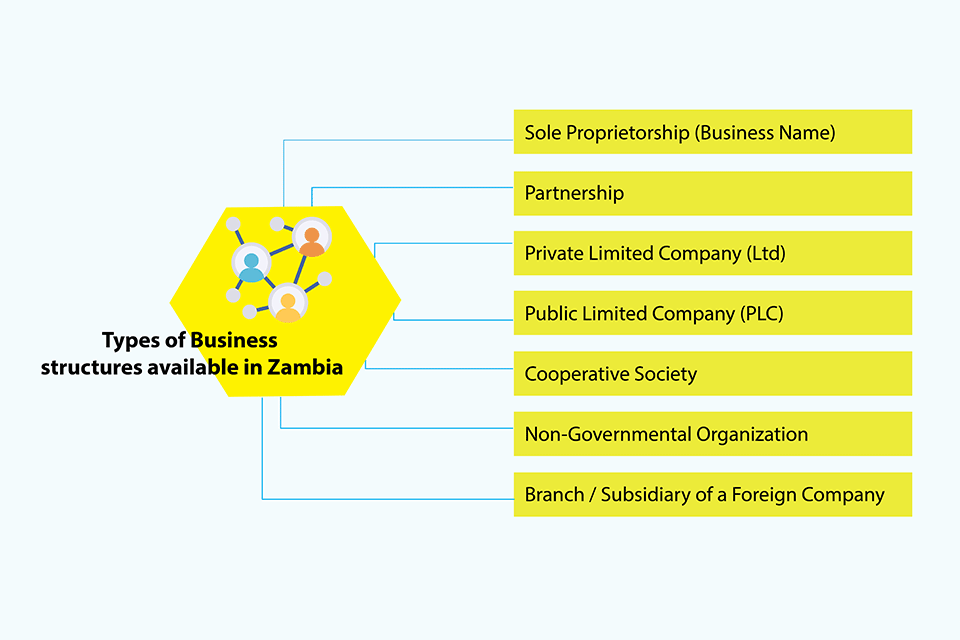
Types of Business structures available in Zambia

In Zambia, the Patents and Companies Registration Agency (PACRA) recognizes several types of business structures that entrepreneurs can choose from, depending on their size, goals, and compliance needs. 

1. Sole Proprietorship (Business Name)
Description

A business owned and managed by one individual.

Key features
  • Easiest and cheapest to register.
  • No legal distinction between owner and business.
  • Owner bears unlimited personal liability.
Best for

Small businesses, shops, salons, or startups testing an idea.

2. Partnership
Description

Two or more people run the business together under a partnership agreement.

Key features
  • Partners share profits, responsibilities, and risks.
  • Not a separate legal entity (partners are personally liable).
  • Requires a clear agreement to avoid disputes.
Best for

Professional services (law firms, accountancy, consultancies).

3. Private Company Limited
Description

A separate legal entity owned by shareholders and managed by directors.

Key features
  • Provides limited liability protection to owners.
  • Can have 1–50 shareholders.
  • Cannot offer shares to the public.
  • Subject to more compliance (annual returns, audited accounts).
Best for

SMEs, startups seeking investment, companies with growth ambitions.

4. Public limited company
Description

A company that can sell shares to the public and list on the Lusaka Securities Exchange (LuSE).

Key features
  • Must have at least 2 directors and 7 shareholders.
  • Subject to strict regulation, disclosure, and reporting requirements.
  • Suitable for large businesses raising capital from the public.
Best for

Large corporations, banks, telecoms, mining companies.

5. Cooperative Society
Description

A member-owned business structure registered under the Cooperatives Act.

Key features
  • Members pool resources and share profits.
  • Common in agriculture, savings groups, and community-based ventures.
Best for

Farmers, community savings groups, collective trade.

6. Non-Governmental Organization (NGO) / Non-Profit Company
Description

Registered as a company limited by guarantee (no shareholders, only members).

Key features
  • Exists to serve a social purpose, not to make profits.
  • Surpluses are reinvested into the mission.
  • Regulated under the NGO Act and PACRA.
Best for

Charities, community projects, advocacy groups.

7. Branch / Subsidiary of a Foreign Company
Description

A foreign company may register a branch or subsidiary in Zambia.

Key features
  • Subject to Zambian laws, taxes, and reporting obligations.
  • Can be structured as a subsidiary (local Ltd) or a branch of the parent.
Best for

Multinationals, regional expansions into Zambia.

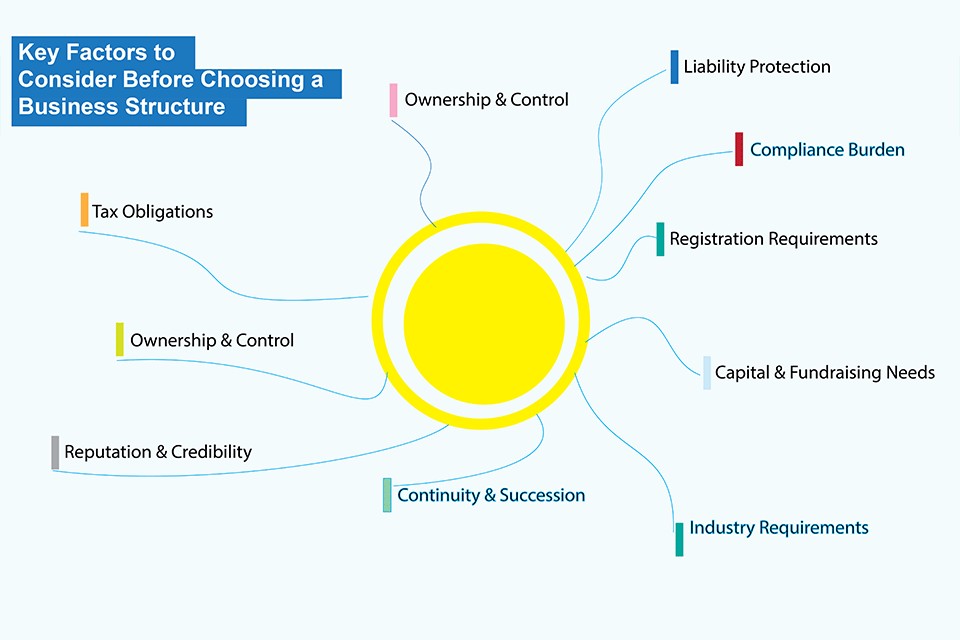
Key Factors to Consider Before Choosing a Business Structure

1. Liability Protection

Sole proprietorships expose your personal assets if the business fails or is sued. Companies (Ltd) provide limited liability, meaning your personal assets (house, car) are protected.

2. Tax Obligation

Different structures are taxed differently by the Zambia Revenue Authority (ZRA). Sole proprietors pay personal income tax; companies pay corporate tax (30% standard).

VAT registration may be mandatory if turnover exceeds the threshold (ZMW 800,000).

3. Registration Requirements

With PACRA (Patents and Companies Registration Agency): Business Name registration = simpler, cheaper, but less protection. Limited Company = more paperwork, annual returns, and compliance.

4. Capital & Fundraising Needs

If you plan to attract investors, banks, or venture capital, a Limited Company is usually required. Sole proprietorships and partnerships find it harder to raise external funding.

5. Ownership & Control

Do you want to run it alone, or share ownership with partners?  Partnerships must define rights and responsibilities clearly; companies offer shares.

6. Cost & Complexity of Setup

 Business Name: Quick and low cost (~ZMW 150–200 for registration).  Limited Company: Higher fees, annual returns, audited accounts required.

7. Continuity & Succession

Sole proprietorship ends with the owner; companies have perpetual succession.

Important if you want to build a long-lasting brand.

8. Industry Requirements

Some sectors (e.g., mining, finance, telecoms) may require incorporation as a company to meet licensing and regulatory standards.

9. Compliance Burden

Companies must file annual returns, pay NAPSA, and comply with labor laws.

Sole proprietors have lighter obligations but limited credibility.

10. Reputation & Credibility

A Limited Company may look more professional to banks, suppliers, and clients. This can be critical for winning tenders (ZPPA) or contracts with corporates.

Step 4 Choose a business name

Step 6 Register your business