
How to Fund your Business
A structured list of ways a business can raise funding in Zambia, covering both formal and informal sources, tailored for startups, SMEs, and established companies:
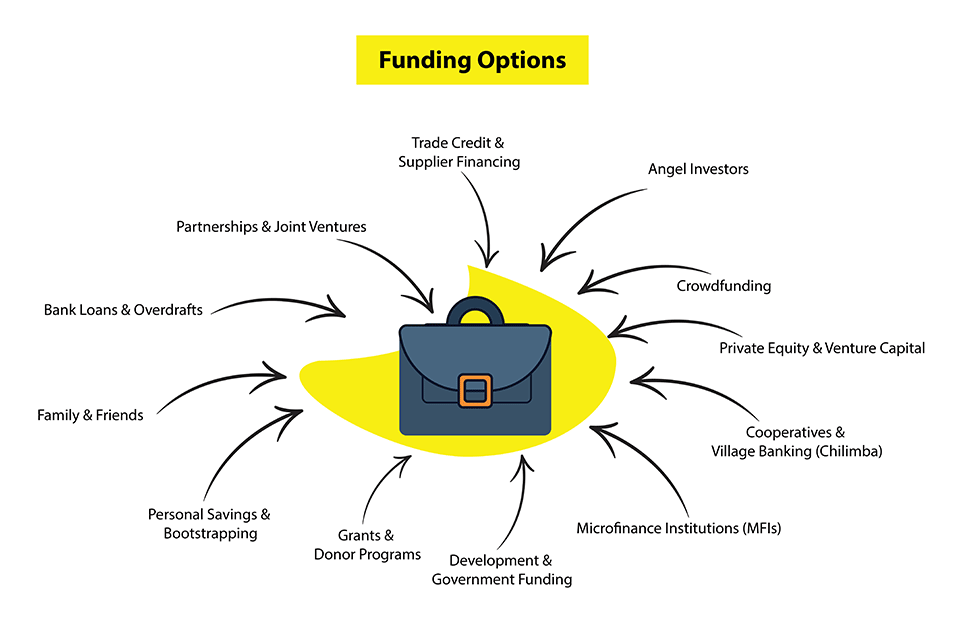
1. Personal Savings & Bootstrapping
Using personal funds, family contributions, or reinvesting profits. Common for micro and small businesses.
| Advantange | Disadvantage |
|---|---|
|
Limited by your personal savings. |
Full control with no external interference.
|
|
No debt or repayment obligations. |
High personal financial risk.
|
|
Builds investor confidence by showing
personal commitment. |
May delay scaling compared to external funding |
2. Family and friends
Borrowing or equity contributions from relatives or close associates. Often the first external funding source.
| Advantange | Disadvantage |
|---|---|
|
Large funding amounts available for expansion. |
Require collateral (property, assets).
|
|
Predictable repayment structure. |
Lengthy approval processes and paperwork.
|
|
Builds a business credit history |
High interest rates in Zambia (often 20%+). |
3. Bank loans and overdrafts
Commercial Banks in Zambia (Stanbic, Zanaco, ABSA, FNB, Standard Chartered, Indo-Zambia Bank, etc.) offer:
- SME loans
- Asset financing
- Overdraft facilities
- Require collateral, business plan, and good credit history.
| Advantange | Disadvantage |
|---|---|
|
Large funding amounts available for expansion. |
Require collateral (property, assets).
|
|
Predictable repayment structure. |
Lengthy approval processes and paperwork.
|
|
Builds a business credit history |
High interest rates in Zambia (often 20%+). |
4. Development and Government Funding
Citizens Economic Empowerment Commission (CEEC): Provides targeted loans and grants for Zambian entrepreneurs, especially youth and women.
Development Bank of Zambia (DBZ): Medium-to-long-term loans for SMEs and large businesses.
National Savings and Credit Bank (NATSAVE): SME-friendly loans, often without heavy collateral.
Zambia Development Agency (ZDA): Support with investor linkages and sometimes incentives.
| Advantange | Disadvantage |
|---|---|
|
Tailored for Zambian SMEs and startups.
|
Bureaucracy and slow disbursement.
|
|
Lower interest or subsidized loans.
|
Political influence may affect access.
|
|
Can include training, mentorship, or grant components. |
Funding windows are limited and highly competitive. |
5. Microfinance Institutions (MFIs)
Providers like FINCA Zambia, Bayport, VisionFund Zambia, and others offer small loans with less stringent collateral requirements. Popular with traders and small-scale entrepreneurs.
| Advantange | Disadvantage |
|---|---|
|
Non-repayable funds.
|
Very competitive and limited availability.
|
|
Encourages innovation and social impact projects.
|
Time-consuming proposal processes.
|
|
Often comes with capacity-building support |
Funds may be restricted to donor priorities, not your vision. |
6. Cooperatives & Village Banking (Chilimba)
Informal community-based savings and lending groups. Members contribute regularly and borrow at low interest.
| Advantange | Disadvantage |
|---|---|
|
Easy to access within communities.
|
Limited to small amounts.
|
|
Builds social trust and networks.
|
Relies heavily on group trust and discipline.
|
|
No strict collateral requirements. |
Vulnerable to default if members fail to contribute |
7. Private Equity & Venture Capital
Local & regional investors target high-growth businesses, especially in fintech, agribusiness, and energy. Examples: Kukula Capital, Goodwell Investments, and international impact investors.
Usually require strong growth potential and equity dilution.
| Advantange | Disadvantage |
|---|---|
|
Provides large funding for high-growth businesses.
|
Dilution of ownership and control.
|
|
Brings strategic guidance and networks.
|
Only suitable for scalable, high-growth sectors.
|
|
Flexible repayment—equity-based rather than debt. |
Difficult to access in Zambia (few active VC firms). |
8. Grants & Donor Programs
NGOs and international organizations provide grants for specific sectors (agriculture, renewable energy, women and youth empowerment).
Examples: USAID, UNDP, AfDB, EU programs.
| Advantange | Disadvantage |
|---|---|
|
Non-repayable funds.
|
Very competitive and limited availability.
|
|
Encourages innovation and social impact projects.
|
Time-consuming proposal processes.
|
|
Often comes with capacity-building support. |
Funds may be restricted to donor priorities, not your vision. |
9. Crowdfunding
Online platforms (GoFundMe, Kickstarter) or local cooperative-style fundraising. Still new in Zambia, but some entrepreneurs use social media campaigns for fundraising.
| Advantange | Disadvantage |
|---|---|
|
Raises funds while validating your idea.
|
Requires strong digital presence and storytelling.
|
|
Reaches global audiences beyond Zambia.
|
No guarantee of success—platform fees still apply.
|
|
Can double as a marketing tool. |
Regulatory clarity in Zambia is limited. |
10. Trade Credit & Supplier Financing
Collaborating with established companies who provide funding in exchange for market access or shared operations.
| Advantange | Disadvantage |
|---|---|
|
Shares financial burden and risk.
|
Potential conflicts over decision-making.
|
|
Access to partner’s resources and networks.
|
Profits must be shared.
|
|
Builds credibility and market presence faster. |
Requires careful legal agreements. |
11. Trade Credit & Supplier Financing
Negotiating delayed payments with suppliers or advance payments from customers. Helps with working capital management.
| Advantange | Disadvantage |
|---|---|
|
No upfront cash needed for supplies.
|
Potential conflicts over decision-making.
|
|
Improves working capital management.
|
Profits must be shared.
|
|
Builds trust with suppliers and customers. |
Requires careful legal agreements. |
12. Angel Investors
Wealthy individuals investing in startups in exchange for equity or convertible debt. Less formal but growing in Lusaka’s tech and startup ecosystem.
| Advantange | Disadvantage |
|---|---|
|
Access to expensive machinery without upfront cash.
|
Higher total cost due to interest/fees.
|
|
Payments spread out over time.
|
Risk of repossession if payments lapse.
|
|
Equipment often serves as collateral. |
Usually limited to established businesses with revenue. |